
态势感知Situational awareness
汇集飞行状态、位置与环境信息,为多机协同提供共同的场景认知。
Flight status, position and environmental information give the team a shared view of the scene.
Specialized training / 特殊训练
围绕多机协同、空中对抗与复盘评估,构建贴近实际场景的专项训练。Scenario-based training in multi-UAV coordination, air combat exercises and debriefing.
01 / Overview
蜂群无人系统特种训练是一项面向多机协同与动态对抗场景的专项训练服务。它将技术理解、人员配合、场景演练和复盘讲评串联起来,帮助团队检验协作流程与应变能力。
This specialized service combines technical understanding, team coordination, scenario exercises and debriefing to evaluate cooperation and response.
训练内容可结合对象、场地条件与课目需求配置;具体机型、周期和实施方式以需求沟通后的方案为准。
Aircraft, duration and delivery are defined with the customer based on participants, venue and training goals.
02 / Technology
蜂群无人系统由多架无人机、通信链路和控制系统共同构成。与单机飞行相比,关键在于让各节点了解彼此状态,并围绕同一目标保持协作。感知、通信与控制需要相互配合,才能在变化的环境中持续完成群体任务。
A UAV swarm combines multiple aircraft, communications and control. Its central challenge is to keep participants aware of one another and coordinated toward a shared goal as conditions change.
特种训练关注这一链条在真实演练中的表现:信息能否及时共享,多机能否稳定配合,人员能否理解态势并完成安全处置,以及训练结果能否被清晰复盘。
Training examines information sharing, coordinated behavior, operator awareness, safe responses and the quality of the final debrief.
汇集飞行状态、位置与环境信息,为多机协同提供共同的场景认知。
Flight status, position and environmental information give the team a shared view of the scene.
在无人机与地面端之间交换必要的状态和任务信息,保持协作关系。
Aircraft and ground teams exchange the status and task information needed to stay coordinated.
让多架无人机按共同目标配合行动,并观察场景变化时的协作表现。
Multiple aircraft work toward a shared objective while their coordination is observed as conditions change.
明确演练边界,记录关键过程,评估稳定性、响应与团队配合。
Defined exercise boundaries and recorded events support a review of stability, response and teamwork.
技术背景参考:Integrated Sensing, Communication and Control Enabled Agile UAV Swarm(IEEE Internet of Things Magazine)。以上为通用技术介绍,具体训练内容以项目方案为准。
03 / Vehicle-based launch system
这里的“装载”是指多架蜂群无人机收纳在车载舱体内部,由车辆集中运输和部署。使用时打开顶部发射盖,让无人机依次从车内起飞。
Multiple swarm aircraft are housed inside a vehicle-mounted enclosure for transport and deployment. The upper hatch opens so the drones can launch in sequence.
央视军事报道中的中国电科“阿特拉斯”系统,就是这类设备的公开案例:蜂群2号陆战车与指控车、保障车协同,车体顶部开启后释放无人机。下面的视频用于说明设备形态和工作场景;该系统并非华思未来产品,具体训练设备以项目方案为准。
04 / Training areas
围绕多机配合、态势共享与团队协作开展训练。
Exercises focused on coordinated flight, shared awareness and team cooperation.
在预设规则与安全边界内,组织动态对抗课目。
Dynamic air combat exercises within agreed rules and safety boundaries.
结合过程记录和课后讲评,梳理配合问题与改进方向。
Review session records and debrief the team to identify areas for improvement.
05 / Training imagery
以下为公开无人机与训练场景照片及示意插图,并非华思未来项目实拍。
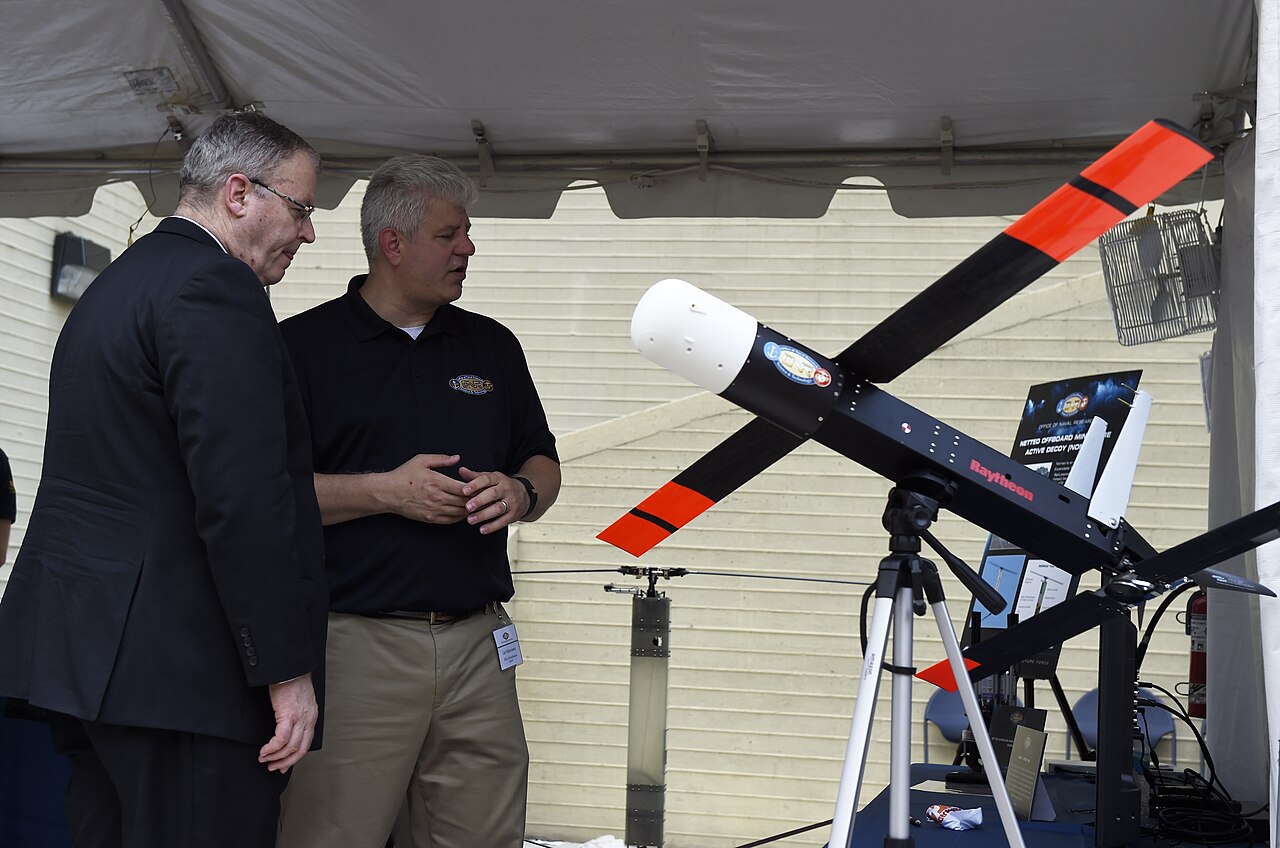
固定翼蜂群无人机原型(美国海军 LOCUST)/ Fixed-wing swarm UAV prototype
美国海军 / John F. Williams · 美国公有领域 · 查看原图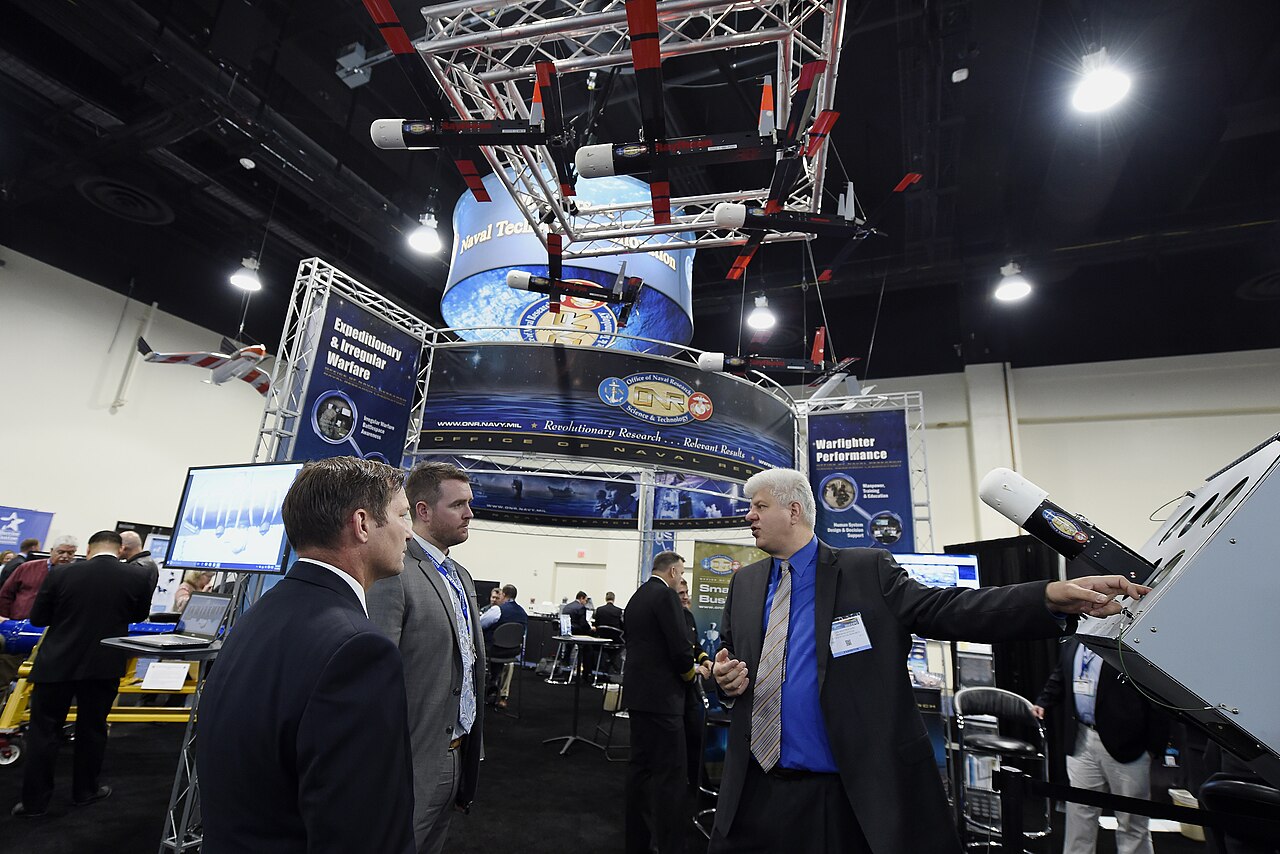
多架固定翼蜂群无人机展示(美国海军 LOCUST)/ Fixed-wing swarm UAVs
美国海军 / John F. Williams · 美国公有领域 · 查看原图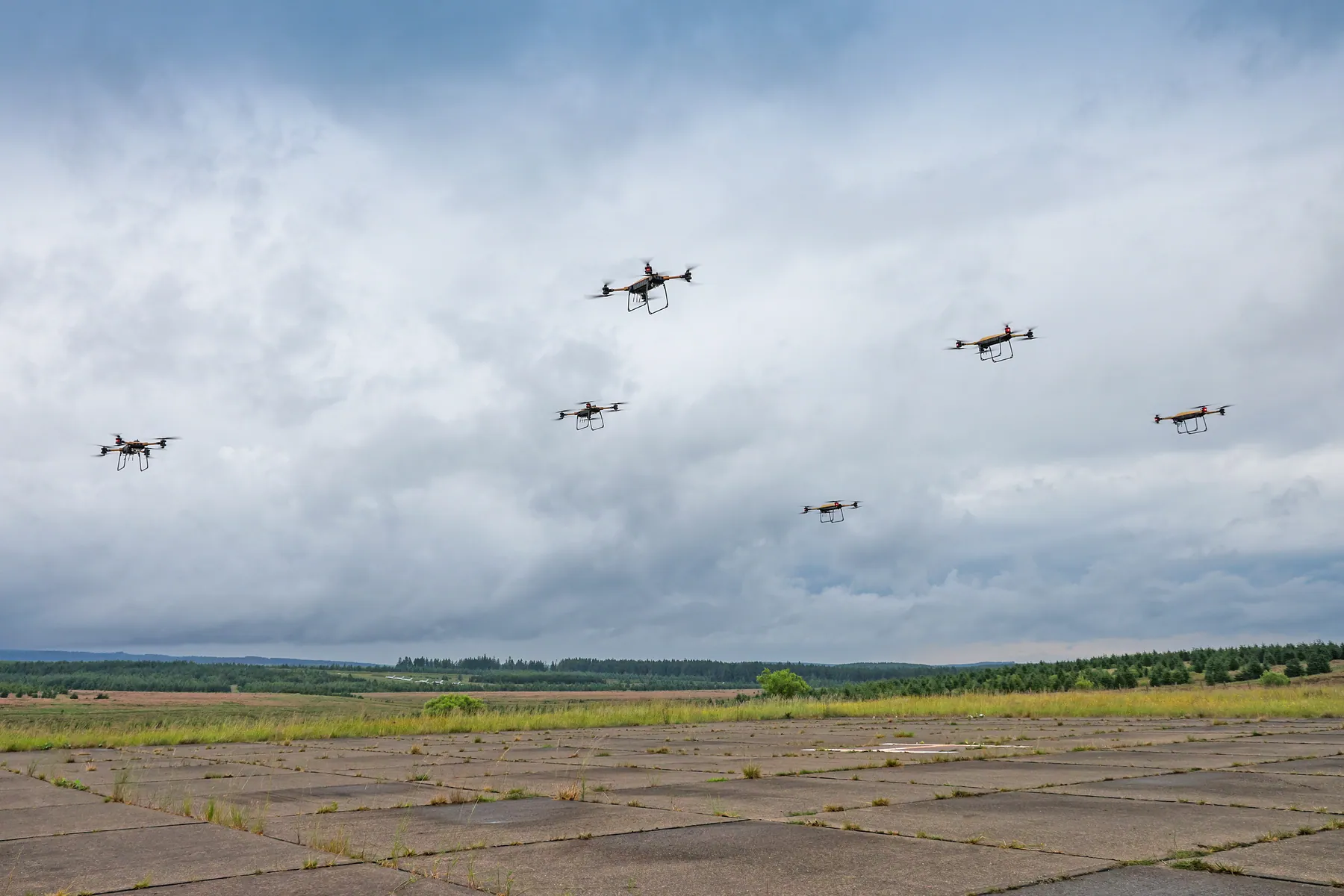
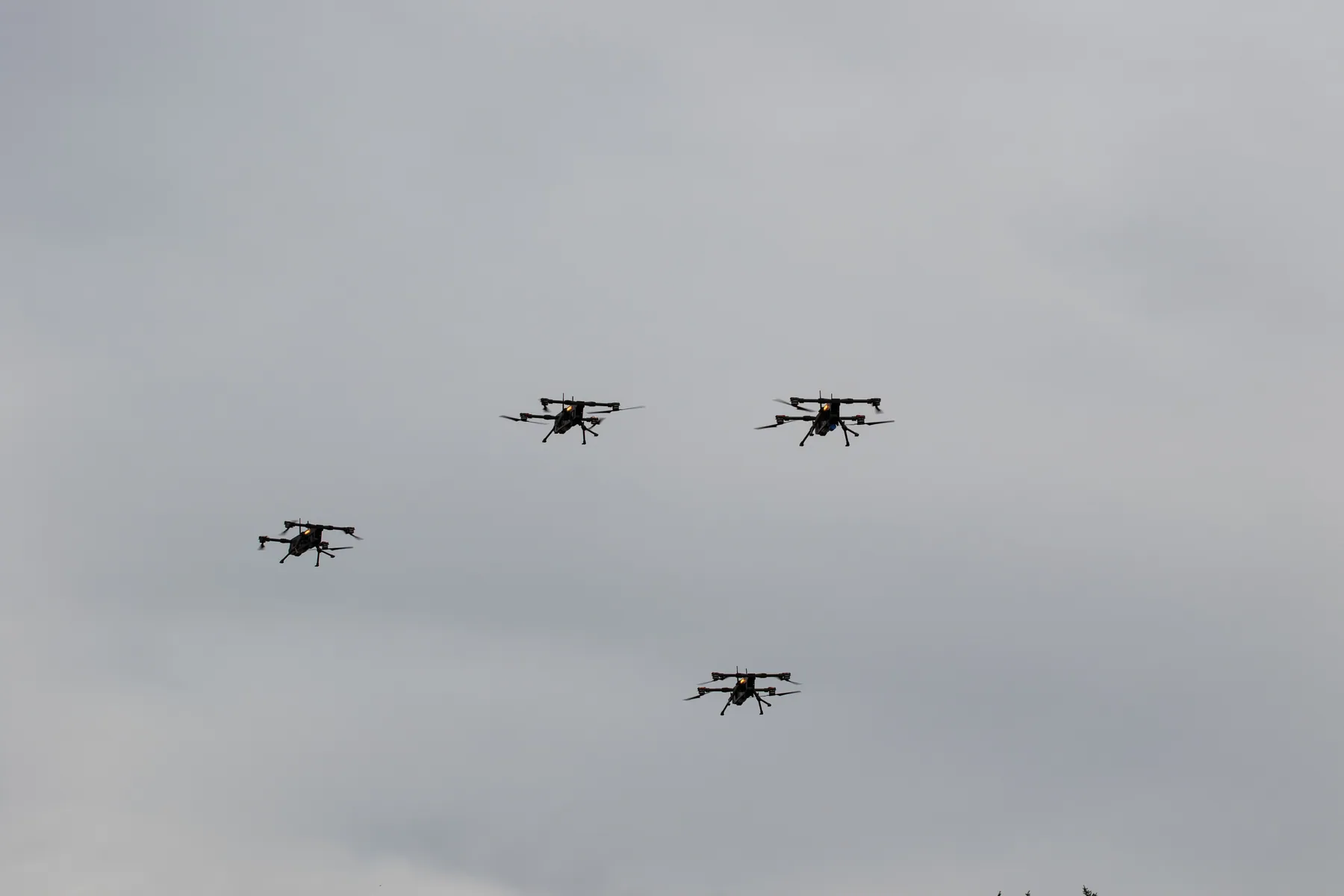
多机编队飞行场景 / Multi-UAV formation flight
UK MOD © Crown copyright 2024 · OGL v1.0 · 查看原图训练场空中协同 / Coordinated flight exercise
美国国民警卫队 / Ayden Norcross · 美国公有领域 · 查看原图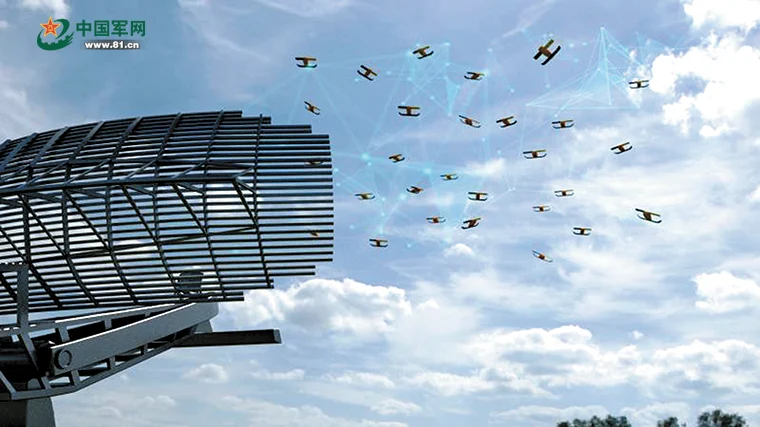
发射装置释放无人机集群示意(网络化协同)/ Launcher releasing a networked UAV swarm
中国军网 / www.81.cn · 示意图 · 查看原图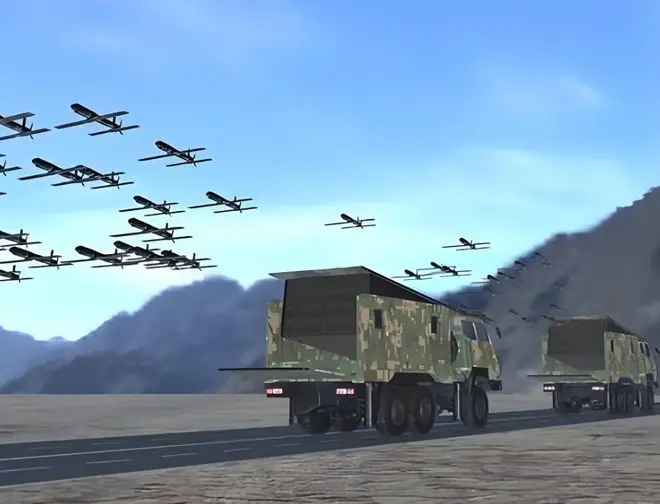
车载发射装置释放固定翼无人机集群示意 / Vehicle-mounted launchers releasing fixed-wing UAVs
公开资料 · 示意图
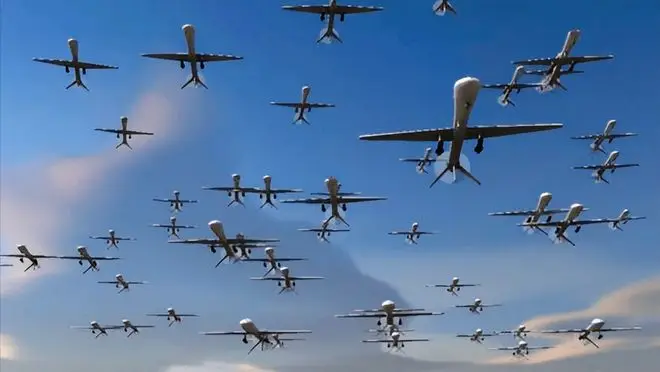
固定翼无人机集群编队示意 / Fixed-wing UAV swarm in formation
公开资料 · 示意图
图片均为外部公开场景素材。英国国防部图片依据 Open Government Licence v1.0 使用;图片来源与授权信息见各图下方。英国国防部及其他图片来源方均未参与或认可本产品。
06 / Related technologies
集群作战仿真与算法Swarm combat simulation and algorithms
本节涉及的技术背景,摘编自《战术导弹技术》2024 年第 6 期《美国无人机集群作战仿真与算法研究进展》(郭楚微、刘晓波、武凤莺等,中国空气动力研究与发展中心)。文章系统梳理了美国在集群协同控制、建模仿真工具和任务战法评估方面的公开研究;原文篇幅较长,下面按原文脉络摘编要点,配图取自原文。
The technical background in this section is excerpted from “Research Progress in U.S. UAV Swarm Combat Simulation and Algorithms” (Guo Chuwei, Liu Xiaobo, Wu Fengying et al., China Aerodynamics Research and Development Center), published in Tactical Missile Technology, 2024, No. 6. The article reviews open U.S. research on swarm cooperative control, modeling and simulation tools, and mission-tactic evaluation. The original is long; the summary below follows its structure, and the figures are taken from the article.
DOI 10.16358/j.issn.1009-1300.20240085 · 阅读原文(微信公众号) · Read the original (WeChat)
原文速览 At a glance
原文把集群协同行为的建模拆成三块。控制架构上,早期普遍采用美国空军研究实验室(AFRL)的统一协同控制架构,分物理层、功能层和态势感知层;随后海军研究生院提出面向任务的可组合架构 MASC,把一项任务逐级拆成阶段、战术、动作和算法,用有限状态机把「任务→算法」串起来,更适合大规模、多任务的集群,也更容易被作战人员理解和使用。
The article breaks swarm behavior modeling into three parts. For control architecture, early work generally used the AFRL unified cooperative control architecture with physical, functional and situational-awareness layers. The Naval Postgraduate School later proposed the task-composable MASC architecture, which decomposes a mission into phases, tactics, actions and algorithms and links mission to algorithm through a finite state machine. It suits large, multi-mission swarms and is easier for operators to understand and use.
航迹规划从动态规划、人工势场等传统方法,转向启发式优化、遗传算法与强化学习。原文举了几个例子:AFRL 与高校合作开发的 Synth4UAV 轨迹规划器可对多类约束建模并自动生成航迹;结合传感器覆盖的启发式方法能提高利用率,并让新航迹尽量贴近原航迹;佛罗里达国际大学用马尔可夫博弈和强化学习做多智能体监控,原文称其性能随无人机数量增加而提升,最高可达 Q-Learning 算法的 200%。
Path planning has moved from dynamic programming and artificial potential fields toward heuristic optimization, genetic algorithms and reinforcement learning. Examples include AFRL's Synth4UAV trajectory planner, which models multiple constraints and generates valid paths automatically; heuristic methods that use sensor coverage to improve utilization while keeping new paths close to the original; and a Florida International University framework using Markov games and reinforcement learning for multi-agent surveillance, which the article reports scales with the number of UAVs and can reach up to 200% of Q-learning's performance.
任务分配主要有拍卖、博弈论、智能优化和强化学习四条路线。拍卖类效率高、扩展性好,但计算成本高,原文认为不适合大规模系统;博弈论方法在多追一逃等对抗关系里更灵活;遗传算法适合多目标组合优化;强化学习把环境建模为马尔可夫决策过程,计算成本适中,适合大规模集群。
Task allocation follows four routes: auction, game theory, metaheuristic optimization and reinforcement learning. Auction methods are efficient and scalable but computationally expensive, which the article considers unsuitable for large systems. Game-theoretic methods are more flexible in multi-pursuer, multi-evader settings. Genetic algorithms suit multi-objective combinatorial optimization. Reinforcement learning models the environment as a Markov decision process, costs moderately and scales to large swarms.
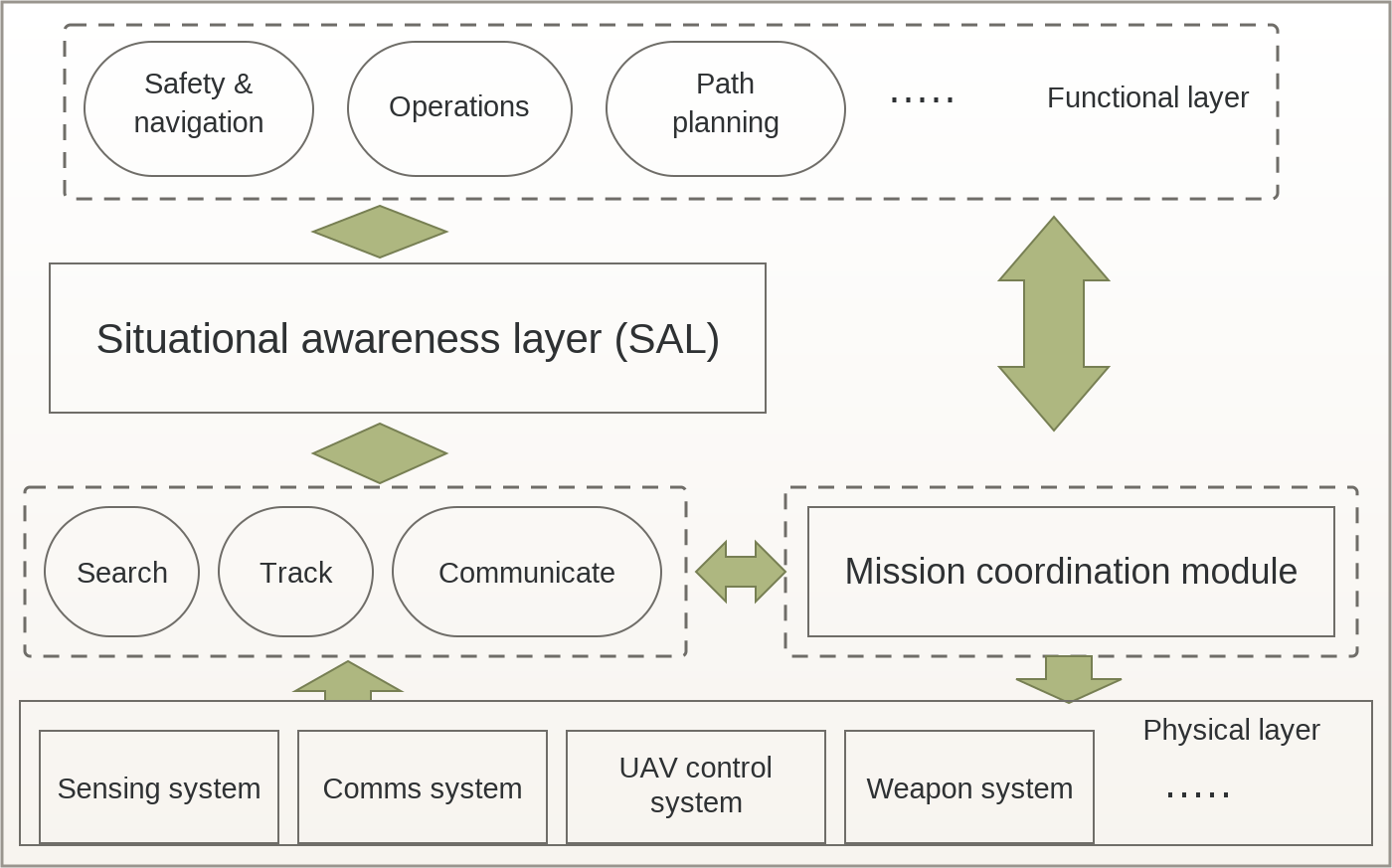
集群系统的分层结构:功能层、态势感知层(SAL)与物理层
Layered swarm architecture: functions, situational awareness and physical layers
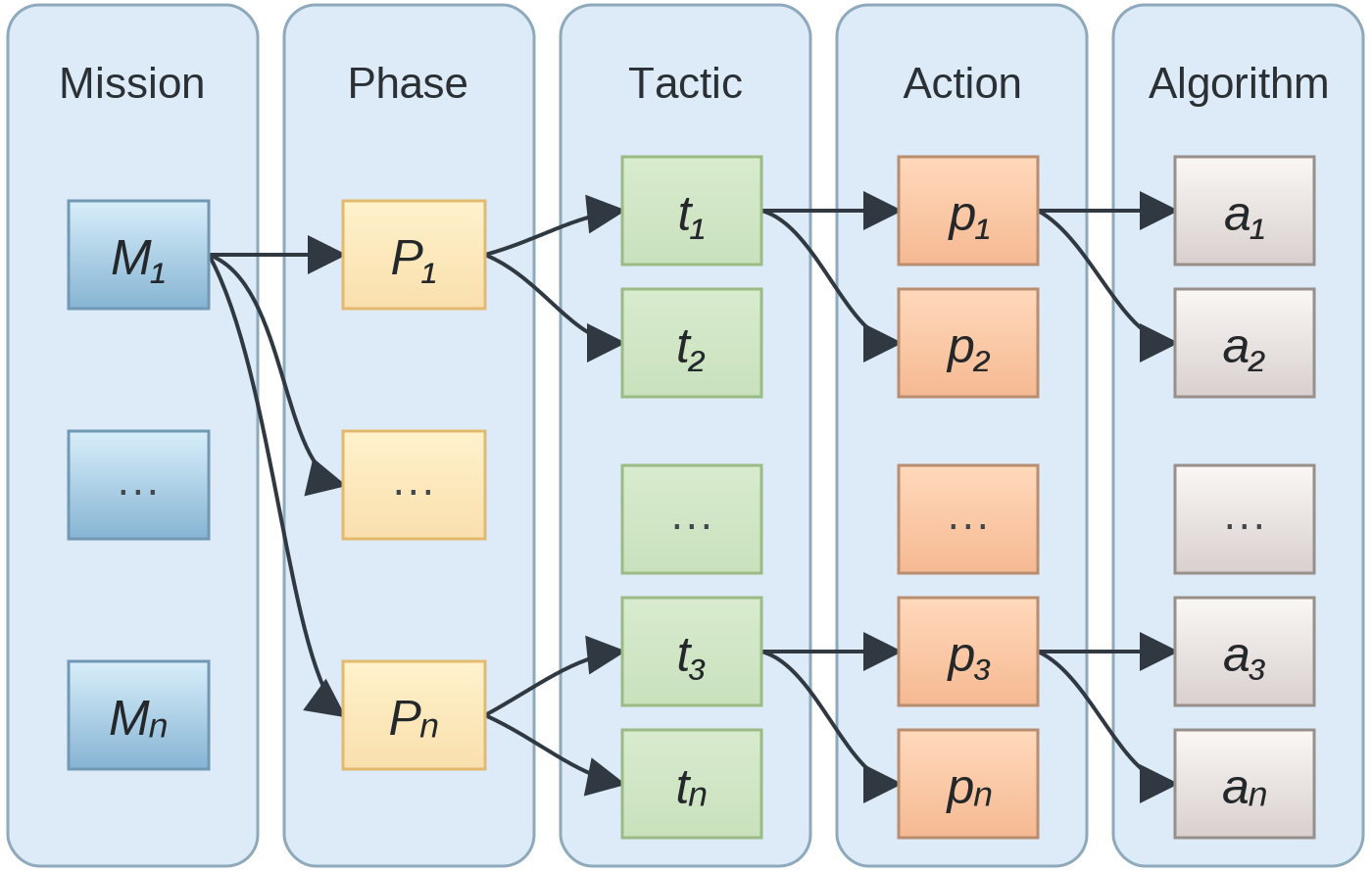
任务—阶段—战术—动作—算法的逐层分解
Decomposition from mission to phase, tactic, action and algorithm
原文把常用工具分成四类。网络模拟器负责通信环境与交互,代表是 NS-3、OMNeT++ 和在此之上扩展的 UAVSim;物理模拟器提供飞行环境、动力学和传感器,包括 AirSim、X-Plane、Matlab、Unreal Engine 与 JSBSim;协同仿真架构把多个模拟器耦合起来,例如 FlyMaster(ROS + PX4 + Gazebo)、FlyNetSim(ArduCopter + NS-3),以及雷锡恩基于 AirSim、ROS 和 ArduPilot 的蜂群仿真环境;地面站与自驾软件则用 MAVProxy、QGroundControl、PX4 和 ArduPilot。
The article groups common tools into four categories. Network simulators model communication environments and interactions, represented by NS-3, OMNeT++ and UAVSim built on top of it. Physical simulators provide flight environments, dynamics and sensors, including AirSim, X-Plane, Matlab, Unreal Engine and JSBSim. Co-simulation architectures couple multiple simulators, such as FlyMaster (ROS + PX4 + Gazebo), FlyNetSim (ArduCopter + NS-3) and Raytheon's swarm simulation environment built on AirSim, ROS and ArduPilot. Ground control and autopilot software include MAVProxy, QGroundControl, PX4 and ArduPilot.
按真实度分,全数字/软件在环完全依赖数学模型,可重复、成本低:早期有 MASON、Swarm.Java、SwarmFare,近期有基于 OMNeT++ 的 UAVSim;DARPA 的 OFFSET 项目直接用 Unity 3D、Unreal Engine 搭可扩展架构,验证了 100 多种蜂群战术。半实物/硬件在环把难以建模的部分接入实物:AFRL 的 OCP-HITL 项目测试了 8 架无人机的飞行控制算法,陆军研究实验室用 X-Plane 加 Matlab 测试了 4 架;2021 年空军技术学院的 SwarmSim 完成 61 架全数字仿真和 4 架 Pixhawk 实机半实物;2024 年佐治亚理工的 MulBERRY 接入 Crazyflie 微型无人机,验证了多种环境与策略下的泛化能力。
By fidelity, full-digital and software-in-the-loop simulation rely entirely on mathematical models and are repeatable and low-cost. Early platforms include MASON, Swarm.Java and SwarmFare; a recent example is UAVSim on OMNeT++. DARPA's OFFSET program used Unity 3D and Unreal Engine to build a scalable architecture and validated more than 100 swarm tactics. Hardware-in-the-loop brings the hard-to-model parts into the loop: AFRL's OCP-HITL project tested flight-control algorithms for eight UAVs, and the Army Research Laboratory tested four UAVs with X-Plane and Matlab. In 2021, the Air Force Institute of Technology's SwarmSim completed a 61-aircraft full-digital simulation and a four-aircraft hardware-in-the-loop run with Pixhawk autopilots. In 2024, Georgia Tech's MulBERRY connected to Crazyflie nano drones and demonstrated generalization across environments and policies.
原文的判断是:全数字仿真适合高频迭代与算法筛选,但它忽略传感器噪声、时延等硬件特性,与实装之间存在控制误差;半实物仿真更接近真实,但受硬件数量限制,目前能验证的集群规模仍然偏小。
The article concludes that full-digital simulation suits rapid iteration and algorithm screening, but it omits hardware characteristics such as sensor noise and latency, leaving a control gap against real systems. Hardware-in-the-loop is closer to reality but limited by hardware availability, so the validated swarm size remains small.
原文把集群作战任务归为协同搜索跟踪、协同自主察打、集群对集群对抗三类。搜索跟踪方面,早期用无人机维护的目标概率分布图在有限通信下搜索;海军研究生院用 K-means 聚类、联合概率数据关联(JPDA)和 Munkres 算法做分布式多目标跟踪,并用卡尔曼滤波改善航迹;2019 年海军水下作战中心提出协作粒子群(CPSO)方法;2021 年安柏瑞德航空航天大学用高低空分层组队做区域目标的持续跟踪,仿真显示分散式方案优于集中式。2022 年杨百翰大学用 NetLogo 对 2500 种初始位置、0–9 架小型无人机和 6 种巡逻模式做了 13 万次模拟,结论是增加数量能提升防御力与生存性,并据此给出巡逻模式建议。
The article groups swarm missions into cooperative search and tracking, autonomous reconnaissance and strike, and swarm-versus-swarm combat. For search and tracking, early work used target probability maps maintained by the UAVs to search under limited communications. The Naval Postgraduate School applied K-means clustering, joint probabilistic data association (JPDA) and the Munkres algorithm for distributed multi-target tracking, with Kalman filtering to refine tracks. In 2019, the Naval Undersea Warfare Center proposed cooperative particle swarm optimization (CPSO). In 2021, Embry-Riddle Aeronautical University used high- and low-altitude layers for persistent tracking of area targets, with simulation showing decentralized schemes outperforming centralized ones. In 2022, Brigham Young University ran 130,000 NetLogo simulations across 2,500 initial positions, 0–9 small UAS and six patrol patterns; it concluded that more aircraft improve defense and survivability and derived patrol-pattern recommendations.
自主察打方面,辛辛那提大学与 AFRL 的 LETHA 用遗传模糊树做多机自主空战决策;美空军先进军事研究学院用有限状态机建模「并行集群进攻」,让集群同时进攻大量冗余节点;JDAFS 模型模拟「空中发射效应」,发现杀伤型与干扰型各 9 架、航速 150 节、射击 5 轮的组合最优;AFSIM 在 A2/AD 场景中评估不同自主等级,发现低水平自主就能显著提升生存性和杀伤率。
For autonomous reconnaissance and strike, the University of Cincinnati and AFRL developed LETHA, a genetic fuzzy tree for multi-UAV autonomous air-combat decisions. The U.S. Air Force Advanced Military Studies program modeled “parallel swarm attack” with a finite state machine so the swarm attacks many redundant nodes at once. The JDAFS model examined “air-launched effects” and found the best mix to be nine lethal and nine jamming ALEs, 150 knots and five firing rounds. AFSIM evaluated different autonomy levels in an A2/AD scenario and found that even low-level autonomy substantially improves survivability and lethality.
集群对抗方面,海军研究生院把对抗视为马尔可夫过程并用 MASON 验证;DARPA 的 SASC 蜂群挑战赛催生了「贪婪射手」「智能射手」「涡流」「分而治之」等战术;2020 年佐治亚理工在自建的 SCRIMMAGE 平台让强化学习机群对阵贪婪射手机群,2v2 至 5v5 的胜率在 0.67–0.89 之间,下图即为这组结果。
For swarm-versus-swarm combat, the Naval Postgraduate School treats engagements as a Markov process and validated the approach in MASON. DARPA's Swarm Challenge produced tactics such as “greedy shooter”, “smart shooter”, “vortex” and “divide and conquer”. In 2020, Georgia Tech pitted reinforcement-learning swarms against greedy-shooter swarms in its SCRIMMAGE platform, with win rates of 0.67–0.89 from 2v2 to 5v5 — the results shown in the figure below.
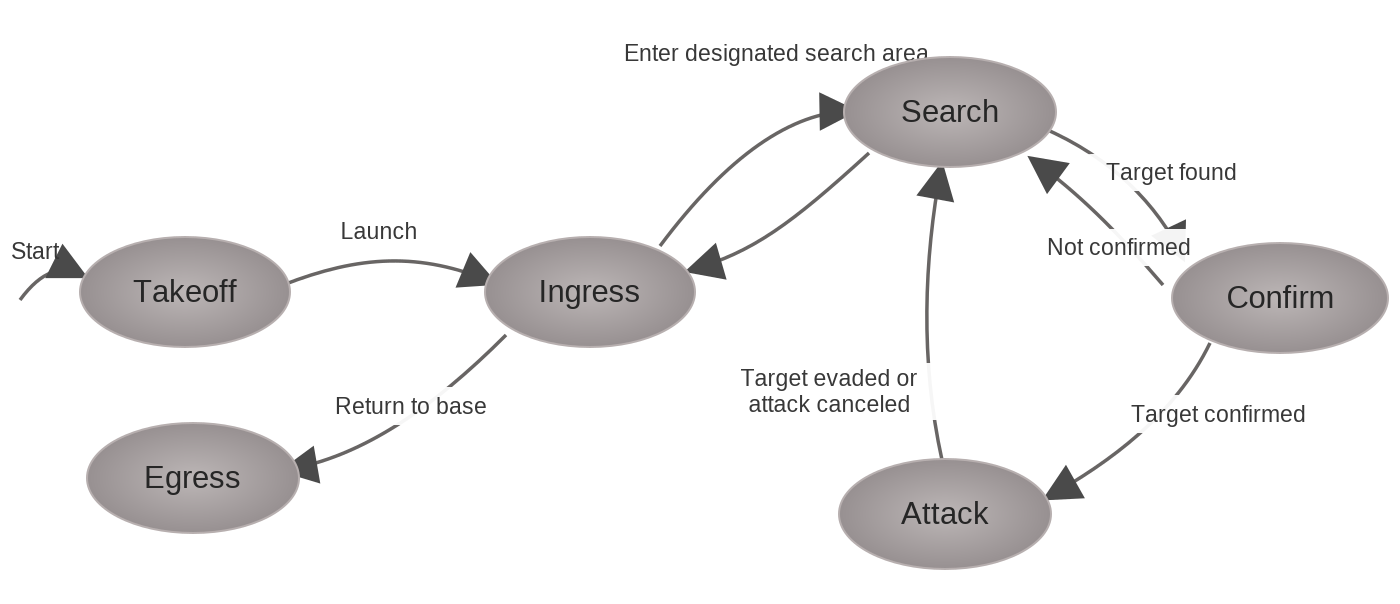
集群任务状态机:起飞、渗透、搜索、确认、攻击与撤离
Swarm mission state machine: launch, ingress, search, confirm, attack and egress
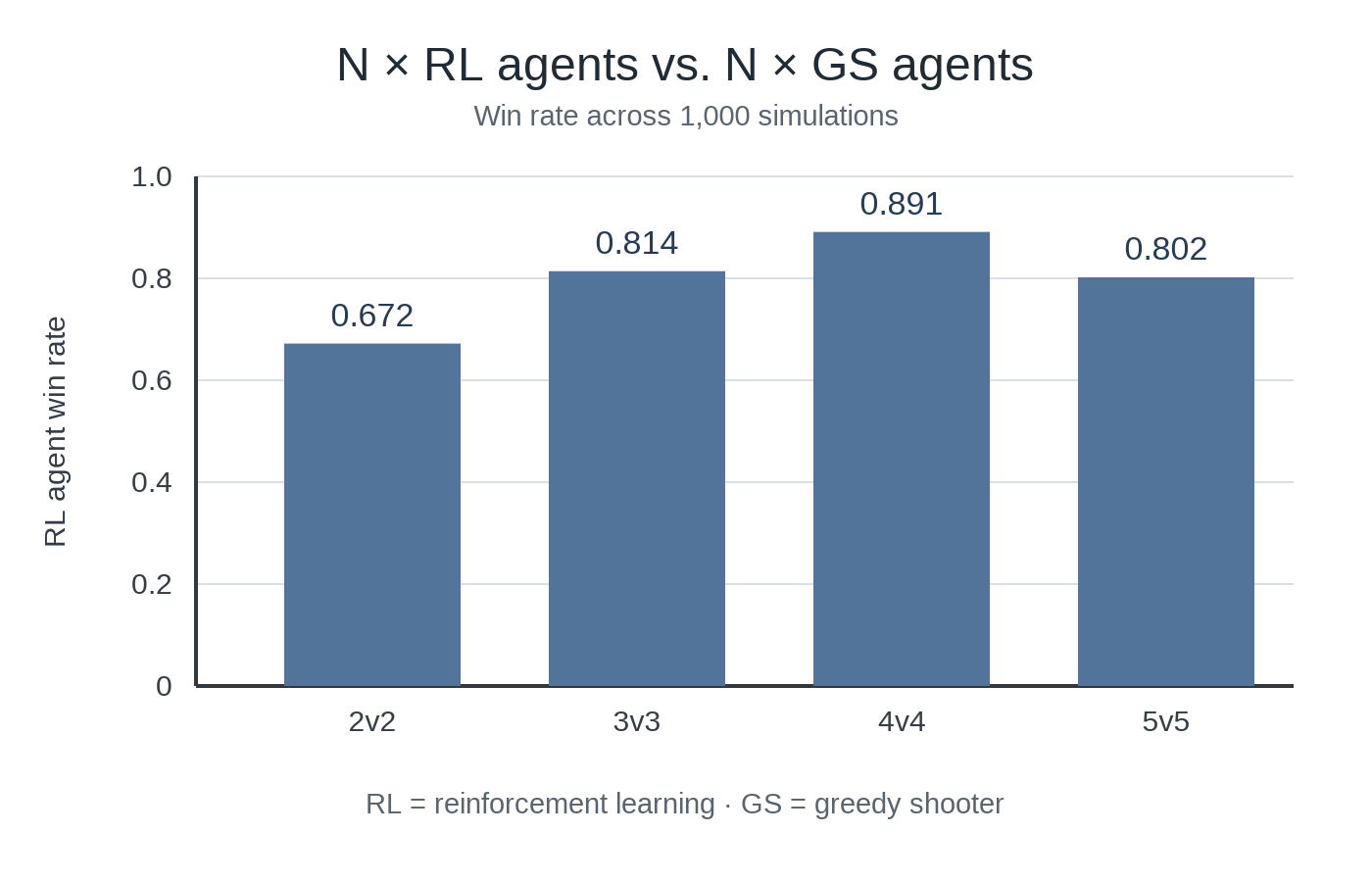
强化学习智能体与基线智能体的对抗胜率(2v2–5v5,1000 次模拟)
Win rates of RL agents against baseline agents (2v2 to 5v5, 1,000 simulations)
原文认为,美国集群作战仿真仍有三方面短板:一是实战关联不足,场景设计偏理想化,大规模集群的协同作战实验数据少;二是仿真精度有限,传感器噪声、时延等硬件特性难以建模,数字仿真与实装之间存在控制误差;三是系统整合困难,控制指令难以实时并行下发给多架无人机,「控制中枢」仍是瓶颈,通信中断或延迟、感知范围受限也会影响协同效果。
The article identifies three shortcomings. First, limited connection to real operations: scenarios are idealized and large-scale swarm experiment data is scarce. Second, limited simulation fidelity: hardware characteristics such as sensor noise and latency are hard to model, leaving control errors between digital simulation and real systems. Third, difficult system integration: control commands are hard to distribute to many UAVs in real time, the “control hub” remains a bottleneck, and communication interruptions, delays or limited sensing can all degrade coordination.
原文给出的发展方向是:多层模块化架构配强适应性的智能规划算法;建设多元集成的通用仿真平台;在作战仿真中强调创新战术和生存性;通过军内联合项目推动仿真与实战一体化。
The article's suggested directions are modular multi-layer architectures with adaptable intelligent planning algorithms; common, multi-integration simulation platforms; an emphasis on innovative tactics and survivability in operational simulation; and joint military projects that integrate simulation with real operations.
对我们的参考(编者观点,非原文结论):把「仿真推演—实装训练—复盘评估」做成闭环——先用低成本仿真试错和筛选战法,再用实装训练验证,最后用过程数据复盘。这正是蜂群特种训练课程设计里强调的三个环节。
(Editor's note, not a conclusion of the article) For our work, the practical lesson is to close the loop of simulation, live training and debriefing: use low-cost simulation to try out and screen tactics, validate them in live training, and review the process data afterwards. These are the three stages emphasized in our swarm specialized-training program.
配图与摘编内容来自上述公开文章,版权归原作者所有;原文为美国公开研究综述,不代表华思未来的研究结论或产品能力。
Figures and excerpted content come from the public article cited above; copyright remains with the original authors. The original is a review of U.S. public research and does not represent HUASI FUTURE's conclusions or product capabilities.
告诉我们训练对象、场地与课目要求,我们将据此沟通适合的方案。
Share your participants, venue and training goals to discuss a suitable plan.